
 Tweet
Tweet
Originally posted by Marke
View Post
-
Maybe it was boost, I used to read that when they were printing it, I'll check my big stack haha.Originally posted by Z-TunedOriginally posted by Wingnut -
Since the big brake kit I have is lighter than OEM, better clamping force, larger rotors and better cooling I can't understand how it would hurt braking performance, then again, I'm the dummy rebuilding a 20 year old car when the Evo X is faster and has warranty Black 1991 GTR. Serious garage stand mantle/parts car.
Black 1990 Pulsar GTiR. Sold
Silver 1989 GTR. Sold
Black 2010 Subaru WRX. Weekend warrior. Sold.
Black 2013 F-150 FX4 ecoboost. Daily driver.
White 2012 Ford Explorer Limited. Family wagon.
Sorry for my offensive comments, I r socially retard.
lolstart by having A ROLLING GTR then we talk u ******* mofo funzy little *****Comment
-
The only way I can imagine a big brake kit hurting stopping distance is if the driver was less able to modulate brake force and locked 'em up.
My OEM brakes with EBC Red Stuff pads and good race fluid have never let me down. I can threshold brake so on a one-time contest I'll bet big brakes couldn't improve my performance. On fast tracks where you're hauling it down multiple times per lap you'd be less likely to experience fade with big brakes.
Dansigpic
The Beaumont ConnectionComment
-
So, how much is a r33/r34 brembo used kit?Need detailing done to your car? I'm open to travel to detail your car :
http://forums.gtrcanada.com/group-buys/54899-ontario-cobraa-detailing-group-buy.html
Please follow my works and latest news/promotion at : https://www.facebook.com/Waxxonspa || Waxxon.com ||Comment
-
You're better off saving you peanuts for Hawk pads or EBC and get better rotors. If you're only after the brembo name, get the cheap covers and don't tell anyone.Originally posted by cobrAA View PostBlack 1991 GTR. Serious garage stand mantle/parts car.
Black 1990 Pulsar GTiR. Sold
Silver 1989 GTR. Sold
Black 2010 Subaru WRX. Weekend warrior. Sold.
Black 2013 F-150 FX4 ecoboost. Daily driver.
White 2012 Ford Explorer Limited. Family wagon.
Sorry for my offensive comments, I r socially retard.
lolstart by having A ROLLING GTR then we talk u ******* mofo funzy little *****Comment
-
Do the Red or Yellow Stuffs squeal? My Hawk HPS pads are so loud, it sounds like porky pig is being tortured by Elmer Fudd.Originally posted by GTR-Dad View PostComment
-
haha f*CK the look, my red painted caliper look great.Originally posted by NismoS-tune View Post
I need pad that won't squeek like my AMS street pad.Need detailing done to your car? I'm open to travel to detail your car :
http://forums.gtrcanada.com/group-buys/54899-ontario-cobraa-detailing-group-buy.html
Please follow my works and latest news/promotion at : https://www.facebook.com/Waxxonspa || Waxxon.com ||Comment
-
After thinking about it, I'm pretty sure SCC mentioned it while talking about their old black project SE-R. I'm pretty sure their problem was only putting big brakes on the front and throwing of the bias.Originally posted by GTR-Dad View PostOriginally posted by Z-TunedOriginally posted by WingnutComment
-
My Red Stuff pads are quiet. Never tryed yellow.Originally posted by Insta_AxE_Toast View Post
Regarding upset bias, that'd hurt all right. If the rears were not pulling their weight you could be getting everything the front tires could deliver, but still leave rear capacity on the table. It'd be even worse on the circuit.
Dansigpic
The Beaumont ConnectionComment
-
and they had to change the valving to accomodate for that, using some parts off an altima i thinkOriginally posted by Velders View Post
ok let's clear up some facts about big brake kits, or plain bigger brakes than original
i study mechanical engineering, so i know a bit about this
lets look at the situation from an engineering point of view (based on fact, knowledge, and calculations)
when SCC did their BBK test using a stock-ish RSX, they found that most BBK took a longer distance to stop from the same speed, why?
because they forgot what was actually touching the road
because, logically (and based on facts) a car cannot brake more than its tires alow it too
which means the maximum a car can deccelarate is based on the grip of the tires and the weight of the car (and wheels)
if you keep the same tires (lets say 300 utg street tires), and install bigger brakes, theres a certain chances you will take a longer distance to stop, why? the brakes overpower the tires
because the braking limit is still dictated by the tires threshold grip, but you are adding the rotational inertia of the larger rotors (rotational inertia grows exponentially with diameter) because they have a larger diameter AND they weigh a bit more, which has a tremendous impact on the total weight of a car
-------------------------------------------------------------------------
ok now lets look at this from another point of view, the advantages of upgrading bigger brakes
i will use a personnal experience for this one,
this summer i went to a track day, a st-croix's riverside speedway near quebec city
there was a nissan 240sx, stripped out, with about 310whp, on racing slicks still using the stock single piston calipers (idiot)
this is how his pads looked at the end of the day, let me explain why
(i pickep them up after he threw them i the trash, before leaving the track)
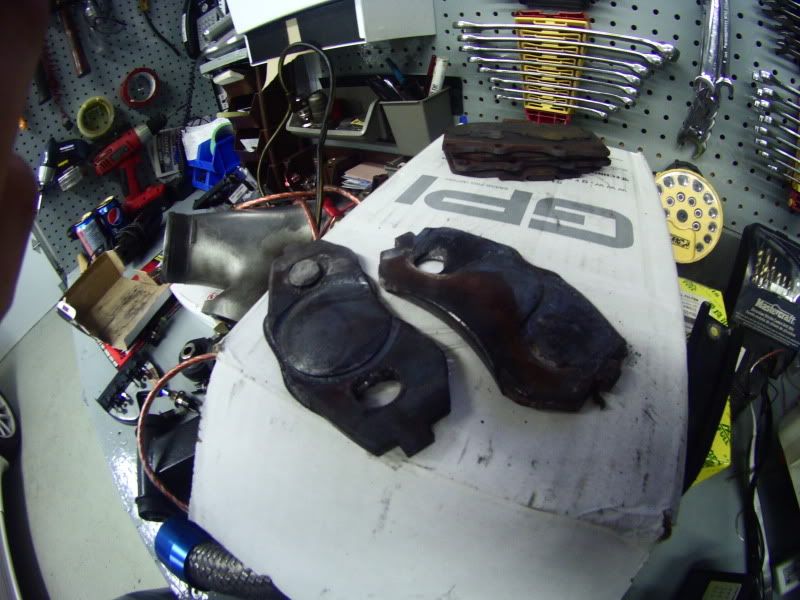
in this case what happened is that the tires overpowered the brakes
the threshold grip of the racing slick tires was much much higher than the maximum braking capabilities of his system
which meant he had to apply an enormous amount of force the pads using the pressure area of only 1 piston,
this caused the pads and rotor to heat up quicker and to an higher temp
the temperature of the pads (porterfield brand) exceeded its designed limits which caused them to desintegrate much quicker to an extent where he did his last 8 laps without any compound left on his pads
this meant the pads metal backing was beeing pushed with tremendous force against the metal brake rotors, again everything heated up beyond the system's limits, and thats why his single piston calipers left prints on the pad's metal backing, and the rotors dug 3mm into those backing
-------------------------------------------------------------------------
in his situation, it would have been extremely advantageous to use bigger brakes,
for example, lets see what would have happened with stock skyline R32 GTR brakes
1st, the bigger rotors,
by using bigger rotors, it means the calipers braking surface is further away from the center of the rotor, why is it better ? lets calculate
the stock s13 front rotors are 257mm
the stock GTR front rotors are 296mm
(296-257)/2= ~20mm, this means that the rotors are 20mm further outwards
lets assume the braking force is the same, the lever (distance from center of rotor to the outer diameter is 15% longer, which means the brake torque is 15% more
2nd, the 4 piston calipers
a single piston caliper pushes the rotor from one side against a flat part of the calip, sliding along the way loosing power
so the braking surface is actually a bit less of the piston's area, = (diamter*pi)*~0.9
i think the piston diameter is about 40mm, so, pressure area is (40*3.1416)*0.9 = 113mm^2
on a forged two piece 4 pistons caliper from a GTR, each piston are paired and they push the rotors against themselves, which doesn't casue loss of power like in the single piston approach
i think the pistons are 25mm in diameter each, so, pressure area, is 4*(25*3.1416) = 314.16mm^2
so the pressure area of the GTR calipers is 178% greater
so if you apply the same force to both systems, lets say 1N (newton force)
s13, 1*113*(257/2) = 14520.5mm/kg of brake torque
GTR, 1*314*(296/2) = 46472mm/kg of brake torque
the GTR's brake system is 220% more powerfull than the S13's
-------------------------------------------------------------------------
another advantage of using bigger brake is, that you have to apply far less force to get the same brake torque as smaller brakes, which means you are creating much less heat
and bigger rotors dissipate their heat much more easely, because of their larger contact surface with the air (inside and outside the rotor)
also, since bigger rotors have more mass, they absorb more heat (energy) so they heat up (temperature) less
-------------------------------------------------------------------------
lets go back to the first topic,
like the saying goes '' you are as strong as your weakest link ''
a car's maximum braking power is dictated by its weakest link, its tires or its brake, whichever is the weakest
for most of you, using stock GTR calipers, driving on 300utg tires, you will never overpower your brakes
and if you don't go to the track, there is absolutely no reason you should need a Big Brake Kit,
to get the most performance without changing calipers,
is to go with better alloy ''plain'' (not cross-drilled, not slotted) brake rotors, like Brembo's rotors
use DOT4 or higher brake fluid, which will absorb alot more heat (energy) before boiling
use nylon/stainless steel braided brake line, that won't expand with heat like rubber lines
use higher temp brake pads, pads that have higher coefficient of friction that can still perform at higher temperatures
for example, hawk HP+ pads work from 30°F to 600°F unlike stocks that only work from -20°F to about 350°F
-------------------------------------------------------------------------
about SCC's big brake kit test,
if they would have used racing slick tires like Hoosiers, tires that no street brake kit could overpower, then they would have clearly seen the difference between each brake kit
-------------------------------------------------------------------------
about front / rear brake bias, not only does it influence the maximum braking performance of a car, but also its handling caracteristics under hard braking (oversteer, understeer)
thats why there are compagnies like Wilwood that make brake bias valves
brake bias is really hard to get right, since it is based on the front and rear weight distribution of a car, its front and rear mechanical grip (suspension setup), its front and rear brake system's power and its front and rear tire grip (if using different compounds)
its something that can take a couple months for a group of engineers to design
-------------------------------------------------------------------------
about brake pads, i will tell you something 99,99% of you don't know, how exactly do brake pads work, why do they squeal?
well, brake pads don't work based on their ''coefficient of friction'' like everybody thinks
the pads performance is based on the ''coefficient of stiction'' or ''sticking coefficient'' between the compound of the pad and the alloy of the rotor
when you brake, a layer of the pad's compound is transfered to the rotor
but only after they have attained a certain temperature (temp range of the pad)
its the stickyness between the pad and the pad's compound on the rotor that actually brakes the car
if the pads worked by friction, brake rotors wouldn't last weeks, they would erode too fast
if you really brake hard all the time, the pads will erode quickly because of all its compound beeing transfered to the rotors
so, before the pads attain that temperature, they work by friction, which makes the rotors resonate (at a certain force application) wich is the squeal you hear
over that range, and the compound with break apart, disintegrate (melt away)
it really depends on how much pressure you apply, even if the pads are hot, if they can vibrate even just a bit, it will make the rotor resonate if the pad's vibration matches the rotor's frequencyOriginally posted by Rapier46 View Post
i.e.
when i drive normally, and my brakes are warm, just just inside the operating temperature
and i brake just slightly, they will squeal, a bit more silent, a bit more squeal
pretty much all sportier pads are like that, just practice to find that spot (pressure) where it doesn't squeal, and always brake with that same pressure and it shouldn't squeal
thats all non-engineers should know about brakes!Comment
-
criss frank, je pensais pas tant connaissait autant!!! Pourquoi tu demandes de l'info d'abord lol!!Need detailing done to your car? I'm open to travel to detail your car :
http://forums.gtrcanada.com/group-buys/54899-ontario-cobraa-detailing-group-buy.html
Please follow my works and latest news/promotion at : https://www.facebook.com/Waxxonspa || Waxxon.com ||Comment
-
Frank, that was a pretty good writeup. IMO that post should be stickied somewhere.
@ NismoS-tune, I'm thinking your car could really benifit from a larger diameter master cylinder, the larger diameter should require more pedal effort to apply the same clamping force as the smaller one. That should make it a little easier to modulate brakes without effortless lock up. It would also help take out any pedal slop you might be experiencing. If you want proof it looks like Frank likes math a little more than I, perhaps he would add it. Originally posted by Z-TunedOriginally posted by Wingnut
Comment
-
Good write up and very educational.
One mistake, I found, is that the following statement is not true.
The reason is that the energy to slow down a car (a mass) from certain speed to another certain speed (Say from 100km to 50km) is always the same. And that energy is transformed to heat during the braking process. Therefore, no matter what brake you have the heat generated in that process will always be the same. (Physics, "Energy always holds same in a close system")Originally posted by frankiman View PostComment


Comment